Local search used to be simple: claim your Google Business Profile (GBP), make sure your Name, Address and Phone number (NAP) were consistent across directories, and aim for a spot in the Google map pack.
Those fundamentals still matter, but they’re no longer enough on their own. Today, almost half of all Google searches have local intent, voice assistants are now a common way to find nearby businesses, and generative AI will often answer a local query before a user clicks anywhere. As the search landscape changes, it’s easy for local business owners to feel overwhelmed.
The good news: you don’t need to abandon everything you know about SEO. In fact, Answer‑Engine Optimisation (AEO) and Generative‑Engine Optimisation (GEO) build on the same foundations as traditional local SEO. This article explains how AEO and GEO affect local visibility and gives you a few practical steps to keep your business in front of customers, whether they’re browsing, talking to a voice assistant or reading an AI‑generated overview.
Why Local Search Is More Than the Map Pack
Google still shows a “3‑pack” of nearby businesses when someone searches for a local service. That visibility matters. Businesses in the local pack get significantly more calls and clicks than those ranked below. But Google and other AI systems now provide answers in more ways than a simple list of links:
- AI overviews summarise information from high‑ranking web pages, the Knowledge Graph, structured markup, Google Maps and third‑party directories. Instead of displaying only links, these overviews pull details like hours, services, pricing, and review highlights into a short paragraph.

- Voice search is on the rise. A survey of U.S. consumers found that 58 % of people have used voice search to find local business information, and 46 % of voice search users look for a local business daily. Voice assistants often read back a single answer or a shortlist. If your business isn’t being cited, you’re invisible to that user.
- People Also Ask and Q&A results display common questions and quick answers directly in the results page. These boxes reward content that answers specific questions clearly.

Because AI summarises information rather than simply listing websites, visibility now depends on the quality and completeness of your data across the web. Inconsistent names or missing details can prevent a business from being included at all.
Managing Your Google Business Profile, Reviews, and Citations Still Matters
Although search interfaces are changing, the fundamentals haven’t. A complete and accurate Google Business Profile remains the most important asset for local visibility. Statistics gathered by marketing platform SOCi show that customers are 2.7 times more likely to consider a business reputable when they find a complete GBP, and 70 % are more likely to visit and 50 % more likely to purchase. Filling out every field: categories, services, hours, products, and high‑quality photos helps algorithms understand what you do and builds trust with potential customers.

Two other signals have become even more important in the age of AI:
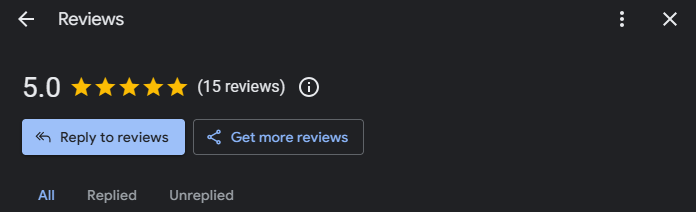
- Reviews and responses. Review volume, recency, and sentiment have long influenced local rankings. In the AI era they influence whether your business is cited in summaries. Research published by Search Engine Journal notes that 92 % of consumers consider responding to reviews to be basic customer service, and 73 % will give a business a second chance if their complaint gets a thoughtful reply. Review responses also create engagement signals and add useful context to your listing, which can help local rankings.
- Third‑party citations. AI systems validate information by cross‑checking multiple sources. Local directories, Yelp, Apple Maps, industry sites, and local news articles all contribute to your authority. According to Local Data Exchange, AI overviews are more likely to mention businesses whose listings are authoritative, consistent, and optimized across platforms. Maintaining consistent NAP information and actively managing your presence beyond Google increases your chances of being cited.
Structuring Your Website and Content for AEO and GEO
AEO and GEO aren’t separate strategies. They simply ask you to present information in ways that are easy for both humans and machines to understand. Here are a few tips for making your website more “answer‑ready” without getting bogged down in jargon:
- Use question‑based headings and direct answers. Organise your pages around the questions your customers ask. For example, instead of a generic heading like “Services,” try “What services does [Your Business] offer?” Then answer it directly in one or two sentences before diving into details. This structure makes it easy for AI to match your content to voice queries or People Also Ask boxes.
- Create location‑specific pages and local content. Instead of one generic “Locations” page, build individual pages for each neighbourhood or service area. Include directions, nearby landmarks, parking information, and hyperlocal keywords. Blogging about community events or writing “best of” guides (e.g., “Best coffee shops near Clintonville”) shows that you understand your local area and helps you appear in conversational AI queries.
- Keep your site fast and user‑friendly. AI doesn’t promote pages with poor technical health. Make sure your site loads quickly, renders well on mobile and returns a valid HTTP status. Good user experience supports both rankings and conversion.
Three Practical Steps to Stay Visible
If you’re wondering where to start, these three steps will give you the biggest impact in an AI‑driven local search landscape. They also happen to align perfectly with the fundamentals of good local SEO.
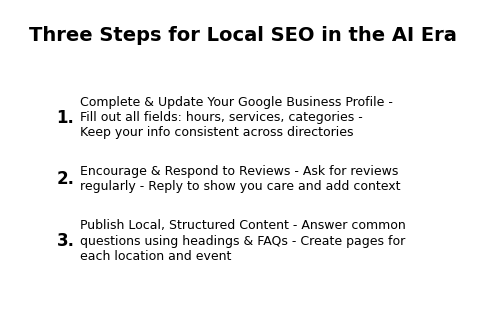
- Complete and regularly update your Google Business Profile. Fill out every section: hours, services, categories, attributes and photos. Keep your business information consistent across all directories. Answer questions posted by customers in the Q&A section. A complete GBP makes your business more trustworthy and provides the data AI systems need to include you in summaries.
- Encourage and respond to reviews. Ask satisfied customers to leave reviews on Google and other platforms. Respond politely to all reviews, especially negative ones. Not only do reviews build social proof, but most consumers expect businesses to respond. Your replies add context and engagement to your listing, which may help with local rankings.
- Publish local, structured content on your site. Create pages and blog posts that answer specific questions customers might ask about your business or your neighbourhood. Use question‑based headings, provide direct answers, and add relevant schema markup. This content will help you appear in People Also Ask boxes, voice search results and AI summaries.
Below is a simple visual summary of these steps. Feel free to save or print it as a reminder.
Final Thoughts and Further Resources
AI hasn’t replaced traditional SEO. It’s added new layers. By focusing on clarity, completeness, and customer engagement, you’ll be ready for whatever search interfaces come next. Local business owners don’t need to become AI experts; you just need to extend the best practices you already know into new contexts.
To help you build and structure pages for AI‑driven results, download our AI‑Ready SEO Checklist. And if you want a deeper dive into how classic SEO works alongside AEO and GEO, check out our pillar article on SEO, GEO and AEO.
Free Download: AI-Ready SEO Checklist
Make your website AI-friendly in 12 simple steps. Download our free AI-Ready SEO Checklist to optimize for AI Overviews, answer engines, and next-gen search — without starting from scratch.