

Ecommerce SEO is one of my favorite spaces because it's a high volume and high opportunity space. Yes, it's crowded and competitive, but there is low-hanging fruit and quick wins to be found. The key to success is creating a holistic SEO strategy for your eCommerce business and then taking a step-by-step approach to SEO.
In this post, I'll walk you through how to craft an eCommerce SEO strategy grounded in real-world marketing. Let's dive in.
How to Create an Impactful eCommerce SEO Strategy
1. Utilize a Customer Acquisition Funnel Strategy for Keyword Research
Engaging in keyword research for an eCommerce website can be overwhelming. There are so many opportunities it's hard to know where to start and when to end.
You can approach it by following a customer acquisition framework to target keywords within the awareness, consideration, and conversion phases of their queries. These phases typically map nicely to content types:
- Conversion is at the bottom of the funnel and maps nicely to the homepage, about page, and reviews.
- Consideration is in the middle of the funnel and maps nicely to collection or product pages.
- Awareness is at the top of the funnel, and it maps nicely to a blog or resource section of a website.
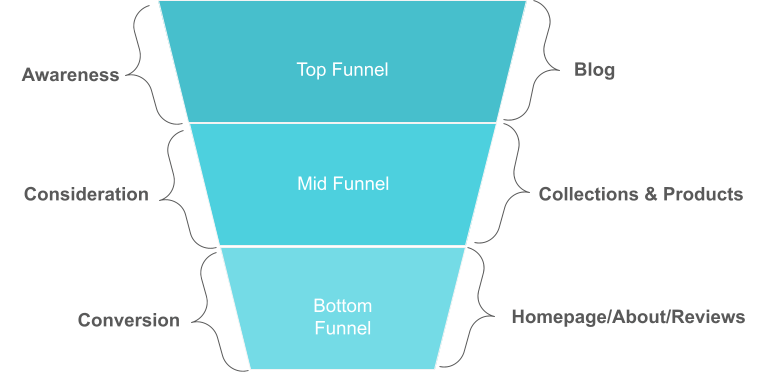
Here's an example for an outdoor industry brand like Mountain Hardware.
Conversion
— mountain hardware
— mountain hardware sale
— mountain hardware reviews
— mountain hardware sleeping bags
— mountain hardware warranty
— mountain hardware tents
— mountain hardware vs patagonia
Consideration
— lightweight tent
— 30 degree down sleeping bag
— women’s hiking pants
— men’s lightweight rain pants for backpacking
— camping gear
— mountaineering gear
— climbing backpack
Awareness
— best tents for camping with dogs
— best down jacket for 8,000 meter peaks
— kilimanjaro packing list
— ski trip packing list
— best treks in the world
— easiest 14ers in colorado
— is mt rainier hard to climb
Mapping your keyword strategy to the customer acquisition funnel enables you to be strategic in the future when it comes to SEO action items. For example, if you are a new eCommerce brand in a competitive space, you may not be able to get SEO traction in the consideration phase. In that case, your blog and the upper part of your acquisition funnel will likely be the name of the game.
2. Content is the Name of the Game
This likely area of low-hanging fruit generates quick wins for your website. There are two primary content plays to consider.
Collection/Category Pages
Creating content for product collection or category pages is a great way to engage in the consideration phase of the keyword funnel.
This includes creating:
- A keyword-friendly header. Ideally, the header is specific.
- Introductory copy. Think 4-6 sentences of content about the collection or category.
- FAQs below the products.
- Testimonials below the products. These could be curated from product reviews that map nicely to the appropriate category.
Blog Posts/Resources Pages
Blog posts and resources are great ways to build awareness. They share expertise and experience and are generally helpful for the intended audience.
Here’s an example of a resource page about How to Tie a Bow Tie. This content serves to reach a key audience for the brand and is helpful. Then, there is a call to action to shop.
Alternatively, here’s an example of a blog post about packing for Kilimanjaro. It’s on an eCommerce website that can then push people to products.
3. Leverage Automation When Possible
eCommerce websites can be large and have many products. You can leverage automation for tasks like page titles and meta descriptions on product pages within many eCommerce platforms. Take, for example, WordPress using Yoast.
You can craft a page title and meta description that automatically generates rather than crafting these for each page individually:
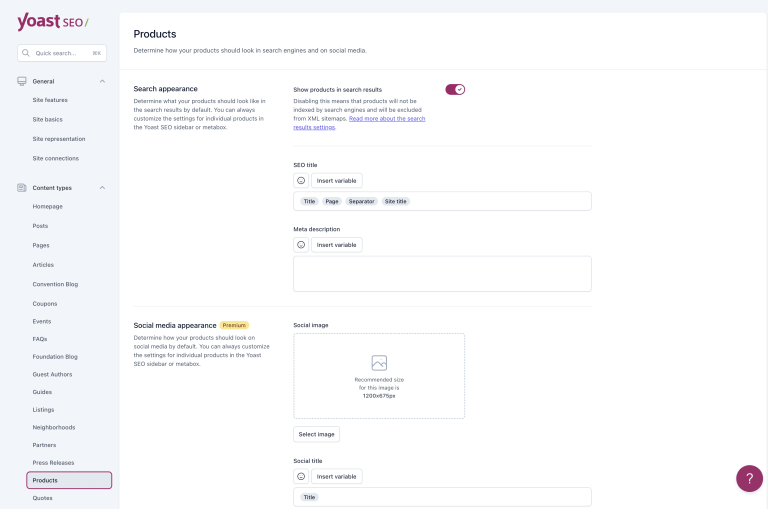
You may also find ways to scale tasks, like using AI to add alternative text to images or managing 301 redirects using rules and patterns.
4. Phase the Work
You don’t have to complete all the tasks at once. Take, for example, keyword research. You don't have to invest in keyword research for your full customer acquisition funnel all at once. You could prioritize the effort to the consideration phase and then circle back down the road to the awareness phase when you'll be ready to invest in blogging.
5. Test Different Strategies for Impact
Before you dive into writing intro paragraphs for 100 category or collection pages, test this strategy for impact. Try doing it for 3-5 pages and see if you can measure a lift in traffic. The same is true for blog posts.
Identify three types of action items you will implement 3-5 times each. Then, you can determine a few months down the line what will be the most impactful action to complete fully.
6. Leverage Schema Markup for Products
Schema markup (also known as structured data) gives Google more context around products. More specifically, it tells Google the product name, price, availability, and more, which can be featured in the snippets on the search engine results pages.
The content management system often automatically creates schema markup. You can test whether it’s working with Google’s Rich Results Test.
7. Link Building Still Matters
The authority of the domain matters in eCommerce SEO. This authority comes from backlinks from high-quality websites.
For large brands and eCommerce websites, much of your authority will come from PR. You may not need to invest specifically in link building.
For newer or smaller eCommerce websites, you’ll likely need to actively invest in link building. You can start small and local by taking actions like joining your local chamber of commerce or getting a mention in your local newspaper, and then branch out to try to get your products and brand into bigger websites like "best of" lists.
SEO Strategy for eCommerce Websites Made Simple
As you create an SEO strategy for an eCommerce website, these seven tips will help you prioritize for impact:
- Utilize a funnel strategy for keyword research
- Content is the name of the game
- Leverage automation when possible
- Phase the work
- Test different strategies for impact
- Leverage schema markup for products
- Link building still matters

Pathfinder makes SEO approachable, impactful and fun!
This course is part of the Pathfinder approach to SEO, a guided system. Membership includes:
Courses — Distilling decades of experience into actionable SEO courses and training. Take a step-by-step approach.
Coaching — You don’t have to go it alone. We’ll be here with group and 1:1 coaching.
Community — Stay updated on all things SEO with our engaged community.
All for $99/month. Cancel anytime.