

The most common questions our SEO coaches get are “How do I put keywords on my website?” and “How do I use keywords for SEO?”
After reading this guide, you’ll never again wonder how to use keywords for SEO. Instead, you’ll have a clear process for proper keyword placement (a.k.a keyword optimization) on every page you create or update on your site.
We aren’t going to get into how SEO works or how to pick the best keywords for your webpages. Although those topics are highly relevant and considered critical SEO learning, we’re going to teach you how to use keywords for SEO with an effective keyword placement workflow.
TLDR — How to Use Keywords for SEO
- You need to choose one focus keyword for each page you want to optimize. Don’t use the same term as a focus keyword on more than one page; each page should have a unique focus keyword. If you choose to ignore this advice, you may end up in a keyword cannibalization scenario.
- Complement your focus keyword with numerous highly-relevant secondary keywords sprinkled throughout the page you are optimizing. These are keywords and phrases synonymous with — or closely related to — your focus keyword. They provide value by giving the search engine more context.
- Place your focus keyword in each of these locations:
- Title Tag / Meta Description
- URL
- H1 Heading
- Subheadings
- Paragraph copy
- Image file names and alt attribute tags
- The anchor text of internal links pointing at the page you are optimizing
- Add your secondary keywords to:
- Subheadings
- Paragraph copy
- Alternative text
- Great keyword placement will not make up for poor-quality content.
- Use a spreadsheet to track your keyword implementation.

Benefits of Properly Adding Keywords
There are multiple benefits to proper keyword placement. Good keywords:
- Send strong signals to search engines about what terms you want your pages to rank for in the search results.
- Make it crystal clear to users what your content is about and provide a high-quality user experience — starting in the search results.
- Enable every page on your site to potentially rank for a variety of highly-relevant search terms.
- Attract high-quality traffic that converts into sales and revenue for your business.
Now it's time to make sure you know the difference between the two types of keywords we’re going to address.
SEO Checklist for Local Businesses
Follow a clear, step-by-step checklist to increase your visibility on Google. This checklist is designed for local and small businesses, along with web designers and agencies. Learn and do at the same time.

Using a Focus Keyword & Secondary Keywords for SEO
In order to decide where to add keywords to your pages, you must first know that Google ranks individual pages — not websites as a whole.
This means each page on your site has the potential to rank for the topic it covers — if you pair it with a focus keyword (sometimes called primary keyword) that people are already using to search for information about that topic.
Supplementing your focus keyword with relevant secondary keywords may allow your page to rank for a wider variety of search terms.
Using Focus Keywords for SEO
If you want a page to rank for a specific search term, it’s recommended that you make that term — or an analogous one — the focus keyword on that page.
For example, let’s say Diet Doctor wants to rank its Ketogenic Diet For Beginners page for the keyword “ketogenic diet” above all other keywords. They’ll want to make “ketogenic diet” that page’s focus keyword, as they have in the example below.

Using Secondary Keywords for SEO
If you want a page to rank for terms that are synonymous with — or closely related to — your focus keyword, then you need to include those secondary words and phrases on the same page as your focus keyword.
For example, if Diet Doctor wants its ketogenic diet page to rank for keywords like “keto diet,” “low carb diets,” etc. — in addition to “ketogenic diet” — those terms get added as secondary keywords on that page. As in the example below.
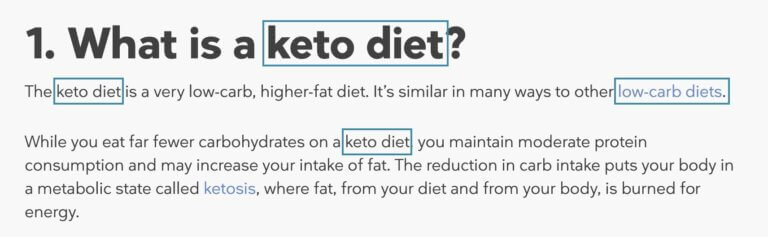
While you only want one distinct focus keyword on a page, it’s okay to incorporate a handful of secondary keywords. And while focus keyword placement throughout your content is A MUST if you want to rank for that specific keyword, placement of secondary keywords is optional (though highly recommended).
In order to pick the best focus and secondary keywords, make sure you spend some time conducting keyword research. A large portion of the Pathfinder SEO Checklist is dedicated to exactly that.
Once you know the difference between focus and secondary keywords and you’ve done your keyword research to choose them, it’s time to place keywords on your pages.
Where to Put a Focus Keyword for SEO
When you’re ready to place any keyword on a page, remember these basic rules:
- Keywords should be naturally incorporated into content in a compelling and informative way. They should never be awkwardly jammed into your webpages.
- Skillful keyword placement should be imperceptible to the average person. Normal users interacting with your content shouldn’t even notice that you are intentionally integrating a keyword.
- If you can’t easily work a keyword into a section of your content, you might need to rework that section or choose a different keyword to include.
Here’s how you can cleverly integrate your focus keyword to maximize SEO impact.
Title Tag & Meta Description
Title tags and meta descriptions are meta tags that communicate to searchers what a page has to offer before they choose which link to click. Google will also take notice of them. Make sure to include your focus keyword in your title tag, ideally near the beginning. Google reads from left to right — just like users — and places more importance on the words at the beginning of a title.

If your focus keyword is more of a phrase and can stand alone to inform users what a page is all about, you can use it as a title tag along with a separator and your brand name. If your focus keyword is short and doesn’t accurately explain what a page is about, integrate additional descriptive text to help.
In the example above, “A Ketogenic Diet for Beginners: The #1 Keto Guide - Diet Doctor” tells users a bit more about the page than “Keto Diet - Diet Doctor” alone would. Using descriptive text like this will help encourage users to click on your title.
It’s also an SEO best practice to include your focus keyword in your meta description. If a user searches for “ketogenic diet” and then sees the exact term they searched for in both your title tag and meta description, they are more likely to click through to your page.
Keywords in URLs
Yes, it is still best practice to include your focus keyword in a page’s URL, even though Google says it doesn’t care about keywords in URLs.
That said, change existing URLs at your own risk — especially if Google already knows a URL and it’s getting lots of traffic. Changing a URL just to include a keyword can have an undesirable impact on a page’s ranking.

However, if you are creating a new page or updating a page that gets very little organic traffic, it might be a good time to consider placing your focus keyword in the slug or file portion of a page’s URL. Many SEO professionals argue that putting a keyword in a page’s URL, title tag, and meta description makes for a more click-worthy search result.
In this example, Diet Doctor chose to use a highly relevant secondary keyword in their URL instead of their focus keyword. Since it looks clean and conveys what the page is about, we can’t argue; however, they could have used their focus keyword instead: /ketogenic-diet.
H1 Heading
Your H1 heading is usually — but not always — the title of a page. It’s also where search engine crawlers will look right after reading a page’s URL, title tag, and meta description to understand what the page is about.
Skillfully integrating a focus keyword into a page’s H1 heading is a must whenever possible.

Subheadings
After you’ve eloquently worked your focus keyword into your H1, see which of your subheadings might also be appropriate places for inclusion.
Your keyword doesn’t need to be included in each and every subheading (that might look a bit like keyword stuffing). Instead, try to include your focus keyword in one or two subheadings, then work secondary keywords into the others.

Paragraph Copy
Ideally, you want to place a focus keyword in a paragraph that’s somewhere near the top of your page. The closer to the top, the better.
Then, make sure to sprinkle that same keyword throughout your copy wherever it makes sense. Note our use of “sprinkle” instead of “jam” — be delicate with its placement in keyword copy and take note when it’s starting to feel like you are overusing it, i.e. keyword stuffing.

A great way to avoid overusing your focus keyword is to use multiple synonymous secondary keywords. In our example, you’ll notice the use of “higher-fat diet,” “keto diet,” and “low-carb diet” regularly in addition to “ketogenic diet.”
Image File Name & Alt Text
All SEO professionals agree that you should include your focus keyword in the image alt attribute of an image, or several, on your page. Most also recommend that you include it in the image filename.
In the example below, you’ll notice that the focus keyword is included in the alt attribute, but not the filename. We recommend playing it safe and including it in both places when possible.

Be careful about keyword stuffing your alt tags, though. Alt attributes exist to help people understand what’s in an image when they can’t see it; they also help search engine crawlers make sense of an image. As a result, you need to use the alt attribute to explain what is actually depicted in the image.
If you can skillfully incorporate your focus keyword into that explanation, great. If you can’t, it might be better to just describe the image and move on. Don’t just jam your focus keyword into image alt attributes if it has nothing to do with the picture and doesn’t make sense.
Anchor Text in Links on Other Pages
One of the many ways search engine crawlers make sense of the content on a page is by reading the anchor text associated with internal and external links pointing to that page.
It’s worth incorporating your focus keyword into the anchor text of any internal links that you can control on your website. In the example below, there’s a blog recommendation at the bottom of a page on the Diet Doctor website. The title text in the link’s anchor tag clearly includes the focus keyword “diet doctor.”

If you can get other websites to include your focus keyword in the anchor tag for any links that point to your site, please do. This can be much more challenging to manage than working with the internal links that you can control on your own site, though.
Where to Put Secondary Keywords
Secondary keyword placement follows a slightly less rigid set of recommendations. It’s often best to add your secondary keywords naturally to your content. Here are some key locations to place them:
Subheadings & Paragraph Copy
Subheading and paragraph copy are the most eligible placements for your secondary keywords. As mentioned above, in an attempt to avoid overusing a focus keyword, it makes perfect sense to add your secondary keywords here instead. See where various secondary keywords have been added in the example below:
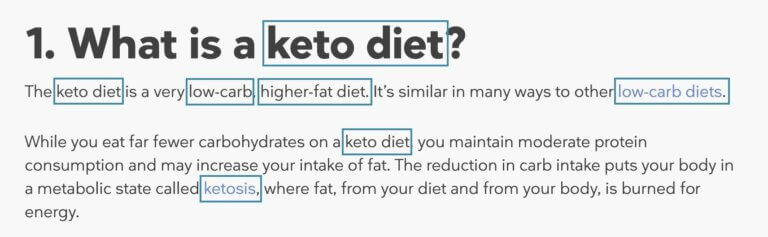
When it comes to secondary keyword placement, sprinkling them throughout your content is the best approach. But be careful about accidentally keyword-stuffing your content by incorporating too many.
You’ll find that by integrating multiple secondary keywords, your content will not only rank better for your focus keyword, but regularly rank for some of the secondary keywords, as well. When your content ranks for a variety of keywords, you are casting a wider net and catching more potential leads and customers.
Image Alt Attributes
Image alt attributes are another great place to add secondary keywords. In the example below, you’ll see that the alt attributes for images on the page contain highly relevant secondary keywords.

Where Not to Put Secondary Keywords
It’s okay to include secondary keywords anywhere as supplements to your focus keyword; they can even replace your focus keyword if it’s getting a bit too repetitive.
That being said, you don’t want to include secondary keywords in place of your focus keyword until you’ve used your focus keyword at least once in each of the recommended places.
Great Keyword Placement is a Poor Substitute for Useful Content
If you look at the example we’ve been using throughout this guide, you’ll notice it‘s an AMAZING piece of comprehensive content that links to related articles on the site, and also incorporates keywords very well.
Quality keyword placement can help any content punch slightly above its weight class; however, keywords in all the right places won’t guarantee that Google and other search engines will decide your page is worth ranking.
Why are we bringing this up?
It’s important to remember that perfect keyword optimization is no substitute for amazing content. For best results, create useful content first and then properly optimize it with your focus and secondary keywords.
Keyword Optimization Process
Keyword Placement Checklist
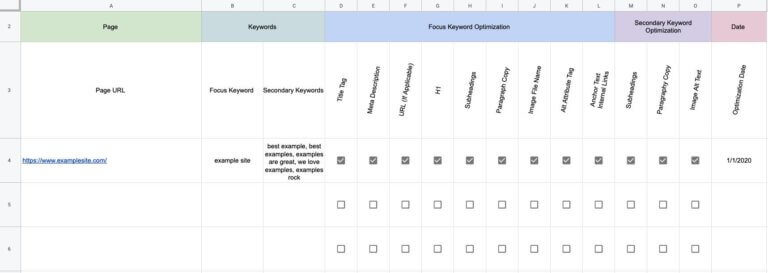
Whether you're adding new content to your site or trying to optimize existing pages with freshly found keywords, it’s worth tracking your optimization efforts in a spreadsheet. This will allow you — and anyone else on your team — to stay on the same page when it comes to your keyword strategy and implementation progress.
This is especially helpful when you analyze your keyword performance with tools like Google Search Console.
Keyword Placement Tracking Template
You can start to track all of your keywords in a sheet. All Pathfinder SEO Subcribers have access to our SEO Workbook which includes sections for Keyword Research and Keyword Mapping for the On-Site SEO. You can sign up for access here.
Auditing Keyword Use on Pages
While software, plugins, and various tools can help you assess how many times you've used keywords for SEO on any given page, we like the good old fashioned Command + F (mac) or Control + F (PC) to find keywords used on a page.
Simply plug your focus and secondary keywords into the Find field (one at a time) to see every instance of a keyword on a page. While this may seem archaic, we find that it’s the best (and fastest) way to spot potential keyword bloat or notice important keywords missing in the content.
Using ChatGPT to Support Keyword Implementation
AI tools like ChatGPT can be helpful allies when it comes to working keywords into your content. While strategy and final edits should always come from a human, ChatGPT can accelerate the writing and optimization process, especially when you’re trying to use focus and secondary keywords more effectively.
Here’s how to use ChatGPT in your keyword workflow:
-
Paste your content draft into ChatGPT along with your list of focus and secondary keywords.
-
Ask for suggestions on where to naturally incorporate the keywords, or to rewrite a paragraph using a few specific keywords.
-
Use it to identify opportunities to add FAQs, headings, or subtopics that include your secondary keywords.
-
If you’re working on a meta description or title tag, you can ask ChatGPT to generate several options based on your content and target keywords also.
As always, review the output to ensure it aligns with your tone and SEO goals. Think of ChatGPT as a brainstorming partner that helps you implement keywords more strategically and efficiently.
What's Next
Now that you understand how to skillfully place keywords on your site, it’s time to take action. Start by choosing one high-priority page on your website — perhaps your homepage, a core service page, or a popular blog post. Use the keyword optimization checklist from this guide to review and update the content with a clear focus keyword and a few relevant secondary keywords. Small, consistent improvements like this can add up to big gains in visibility over time.
We're Here to Help
At Pathfinder SEO, we specialize in making SEO approachable for everyone — whether you’re a small business owner, a freelancer, or part of a growing agency team. If you’re looking for more step-by-step guidance, check out our SEO Checklist for Local Businesses. It’s packed with practical advice to help you improve visibility on Google, one simple step at a time.
Want ongoing support and access to all our SEO training resources? Join our guided SEO membership to get full access to our course library, community, and coaching — everything you need to confidently implement SEO and see results.

Pathfinder makes SEO approachable, impactful and fun!
This course is part of the Pathfinder approach to SEO, a guided system. Membership includes:
Courses — Distilling decades of experience into actionable SEO courses and training. Take a step-by-step approach.
Coaching — You don’t have to go it alone. We’ll be here with group and 1:1 coaching.
Community — Stay updated on all things SEO with our engaged community.
All for $99/month. Cancel anytime.